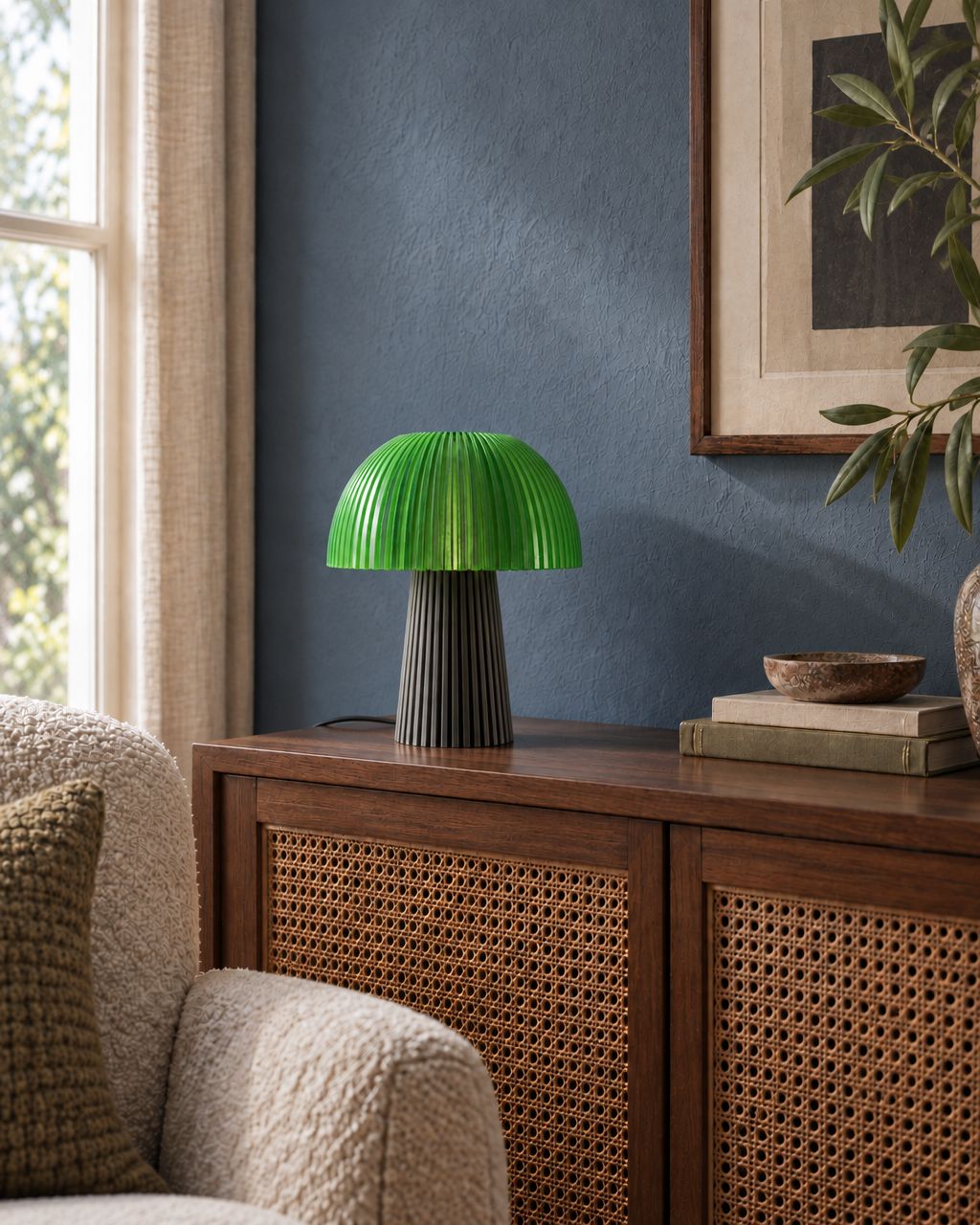
Choose a sculptural table lamp that works in daylight. Compare HALO and CALYPSO by shape, shade width and texture, then check the warm evening glow.
In this story (14 sections)
At a glance
Judge a sculptural table lamp switched off by its complete outline, surface texture and relationship to the furniture—not just the shade. Start with a daylight photograph, check the full dimensions, then use the illuminated view as a separate test of the light you want.
TL;DR
• A sculptural table lamp should earn its place in daylight, not only when glowing.
• HALO suits a side table with space for its broad, ribbed dome.
• CALYPSO gives a console a taller silhouette; check its full shade width.
• Measure the shade as well as the base. A small footprint can hide a wide top.
Why daylight matters
A lamp does not disappear when you switch it off. Its color sits beside the wood, fabric and objects you already live with. Its outline interrupts the wall behind it, or blends into it.
That makes a daylight photograph useful buying evidence. An evening image shows the glow; it does not tell you everything about the unlit color or the balance between base and shade. Our guide to nature-inspired table lamps explores how a recognizable silhouette can work without turning a room into a theme.
Choose a form you enjoy before asking it to become a light. Then check that the light serves the place you have chosen. Neither decision replaces the other.
How do you judge a sculptural table lamp when it is switched off?
Use the same checks whether you are choosing a soft dome, a scalloped shade or a straight-sided form. You are not trying to find an object that matches every finish in the room. You are deciding whether it makes sense on one particular surface.
• Look at the whole silhouette. Include the base, shade and the empty space between them.
• Compare it with the furniture. A long cabinet and a small side table give the same lamp different surroundings.
• Read the surface in ordinary daylight. Look for ribs, visible layers and the way shadows describe the form.
• Check the shade width. Do not use the base footprint as the only measure of fit.
• Find the cord route. The arrangement still needs to work once you plug it in.
• Return to the illuminated view. Decide whether the evening effect suits the job, rather than assuming an attractive shape guarantees useful task light.
Keep a photograph of your actual surface beside the product image. You will notice conflicts sooner: a shade behind a plant, an awkward height below a picture, or a cord with nowhere sensible to go.
Read the outline before the details
A strong outline stays legible at room distance. Step back from the product photograph, or make it smaller on your screen. Notice whether you still understand the relationship between the top and the base.
There is no requirement for symmetry or a traditional shade. The useful question is whether the shape feels intentional to you from the positions where you will see it. A lamp photographed straight on can look different from the side of a sofa or the doorway.
Ask for another angle when one image leaves a question unanswered. A three-quarter view can show shade depth, while a side view reveals how far the form projects beyond its support. Avoid deciding from a tightly cropped detail photograph alone.
Try these checks against your room:
• Does the top compete with the lower edge of a framed picture?
• Can you see the outline against the wall rather than through a cluster of leaves?
• Does the lamp leave enough visual space beside the objects you want to keep?
• Do you like the shape from your usual seat, not only from the camera position?
Removing an accessory is often a more useful experiment than adding one. Give the lamp enough space to describe itself before deciding that the arrangement needs more decoration.
Let daylight reveal the texture
Ribs and printed layers change how a surface catches light. In a daylight image, look at both the bright side and the shaded side of the lamp. Fine shadows can make a repeated structure easy to read without the bulb doing any work.
A smooth-looking photograph is not a promise of a smooth surface. Image size, focus and the direction of the light affect how much detail you see. If texture matters to your decision, compare a close-up with the complete lamp rather than treating either image as the whole story.
For a 3D printed lamp, keep appearance separate from performance. Visible layers describe part of the making process; they do not establish electrical safety, durability or environmental impact. Those questions need the maker's actual specifications and care information.
Choose texture because you like seeing it. Do not buy a ribbed form expecting it to look like an uninterrupted ceramic surface in every kind of light.
Two silhouettes, two furniture settings
The current NORE product pages provide a useful comparison between a lower, broad dome and a taller, scalloped form. These are choices of character and fit, not a claim that one lamp is best for every room.
Lamp — Best for — Unlit character — Overall height — Shade width — What to check
HALO — A side table that needs a broad, rounded focal point — Electric Green ribbed dome above a dark ribbed base — 11 inches — 9.5 inches — The wide top needs space even though the base is narrower
CALYPSO — A console or sideboard with room for a taller outline — Pearl flower-shaped shade above a coral cylindrical base — 17 inches — 10 inches — Height and shade width both matter beside artwork and other objects
Dimensions and named finishes above come from NORE's product pages, checked October 28, 2026. Confirm the selected version on its product page before ordering.
HALO: best for a lower, rounded focal point
HALO's dome is the first shape you read. The vertical ribs continue the visual rhythm into a darker, tapered base, giving the green top a clear support rather than another competing feature.
HALO works well when:
• You want a curved silhouette beside straighter cabinet edges.
• The green shade has a background against which you enjoy seeing it.
• Your side table has room for a 9.5-inch-wide top.
HALO is less suitable when: the broad dome crowds the things you use on the table, or you need a focused reading light rather than ambient light. At 11 inches tall, it also gives a lower composition than CALYPSO; choose that deliberately rather than expecting a tall statement piece.
CALYPSO: best for height on a console or sideboard
CALYPSO pairs a pearl flower-shaped shade with a coral cylindrical base. Its scalloped edge gives the top a different rhythm from HALO's dome, while the straight base keeps the lower half visually simple.
CALYPSO works well when:
• A sideboard has space for a pronounced vertical form.
• You want the shade edge to be part of the arrangement even while unlit.
• The coral base belongs in your room's color story without needing everything else to match.
CALYPSO is less suitable when: a low shelf limits the height, a small surface cannot accommodate the 10-inch shade, or the lamp interrupts the view between people. Its 17-inch height is useful only where there is room to see it.
NORE sculptural table lamps suit shoppers who want a visible design object and a warm ambient-light role, rather than a replacement for focused reading light. That distinction matters more than choosing a favorite photograph.
Why the same lamp looks different in different rooms
A daylight image is evidence of character, not an exact preview of every room. Read it alongside the setting in which it was photographed.
• The background changes the outline. A dark base against a dark wall can recede; the same base against a light wall becomes more obvious.
• Nearby colors change the composition. A green dome beside warm wood reads differently from the same dome beside a brightly patterned textile.
• The camera angle changes the proportions you notice. Looking down reveals more of the shade's top; a lower view emphasizes its edge and underside.
• The window describes the texture. Side light can reveal fine ribs that a flat, frontal image barely shows.
• The furniture changes the scale. A lamp alone in a photograph offers fewer size clues than a lamp beside familiar objects.
Use these differences to ask better questions, not to expect a perfect color match from your screen. If a particular finish is crucial, ask the studio for more daylight photographs or a description of how it looks unlit.
Measure the object you will live around
The base is where a lamp touches the furniture. The shade is often the part that occupies the most space. Measure for both.
For HALO, a 4-inch base supports a 9.5-inch-wide shade. For CALYPSO, a 4.5-inch base sits below a 10-inch-wide shade. Those dimensions explain why checking only the base can lead to a crowded arrangement.
Mark the shade width on the surface with removable paper, then imagine its height above that outline. Leave the things you actually use in place: a book, a bowl for keys, a glass or a charging phone. You are measuring a working surface, not preparing an empty display shelf.
Check the route to the outlet before settling the composition. A cord across a walkway is not a styling detail to solve later. A lamp that needs constant moving to open a cabinet or set down a drink belongs somewhere else.
What should the evening photograph confirm?
The illuminated image answers a different question: what becomes visible once the light source is on? Look at the shade, the surface below it and the wall behind it.
A translucent shade can change the prominence of its color and texture when lit. That does not make the daylight appearance less important; it means you are choosing two useful views of the same object. Compare both before deciding.
The NORE product pages describe these lamps as mood lights, not a room's main light. If you need to read or work, keep separate light available for that task. A warm-looking photograph is not a measurement of brightness at the page.
FAQ
Should a sculptural table lamp look good when it is switched off?
Yes. A sculptural table lamp should have an outline, color and texture you enjoy in daylight, as well as a useful illuminated effect. Judge both views before choosing.
How wide is HALO compared with its base?
HALO has a 9.5-inch-wide shade above a 4-inch base, according to the product page checked October 28, 2026. Measure the shade width rather than assuming the base describes the space it needs.
Is CALYPSO taller than HALO?
CALYPSO is 17 inches tall; HALO is 11 inches tall. CALYPSO offers a taller composition for a console or sideboard, while HALO gives a lower dome-shaped outline.
Can a colorful table lamp work against a dark wall?
Yes. Compare the complete lamp against the wall: the shade can remain distinct while a darker base recedes. Use daylight photographs to decide whether you like that balance.
Do visible printed layers mean a lamp is damaged?
Visible layers alone do not establish damage; layered surfaces can be part of the intended printed finish. Compare the object with the maker's detail photographs and ask the studio about any unexpected crack or separation.
Can HALO or CALYPSO replace a reading lamp?
HALO and CALYPSO are presented as ambient mood lights, not focused reading lights. Keep a suitable separate light for sustained reading or work.
One last thing
Look at your proposed arrangement without adding any new accessories. If the lamp already gives the surface a clear shape and a useful evening glow, leave the empty space alone. A sculptural object does not need several smaller objects to explain it.